Music by DANIEL DORFF |
 |
| Five Songs from the Goliards for Tenor voice, Clarinet/Soprano Sax, Bassoon, Trombone, Viola/Percussion, and Cello/Percussion |
|
|
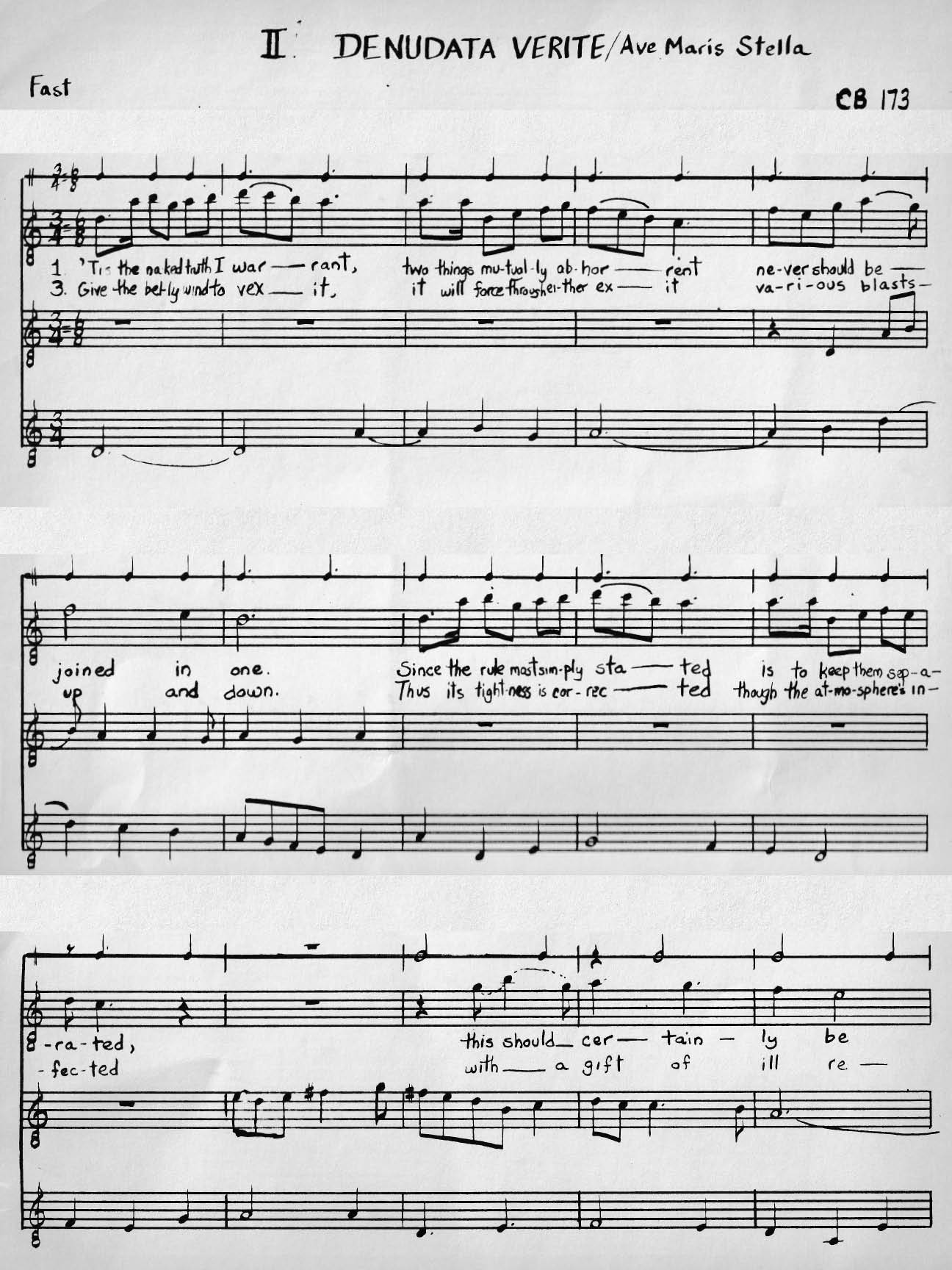
Poems from Carmina Burana, in English translation. DETAILS PREMIERED April 1978, Cornell University. PROGRAM NOTES While certainly a "student work," I gave myself this assignment to assimilate medieval techniques after discovering music of the 13th-14th centuries, knowing this would enrich my skills. The assignment was analogous to studying Palestrina and Bach as part of composers' training -- particularly because this repertoire was the pinnacle of pandiatonic dissonance before the 20th century. The text source "Carmina Burana" refers to a collection of writings by wandering scholars (young adults sometimes known as Goliards), generally about love, life, lust, and liquor. Carmina Burana translates as Songs from Bavaria, and Carl Orff's landmark cantata uses only a small selection from this large swath of literature. As typical of the genre, I wrote several musical lines without instrument assignments, and the premiere was performed by musicology graduate students on their favored instruments plus extra percussion. I. Si me dignetur quam desidero is a three-part love song, modeled after the style of Machaut (the dean of French medieval composers). II. Denudata Verite/Ave Maris Stella starts with a plainchant that remains pure throughout the bass line, while the vocal part sings a rude drinking song to a melody derived from the sacred melody; a middle voice adds an extra line including the chant melody at twice the tempo. III. Nobilis Mei Miserere Precor/Victimae Paschali Laudes is a tender love song whose "tenor" is an isorhythmic use of an Easter plainchant. IV. Sic Mea Fata Canendo Solor, is a through-composed love song, similar in concept to the first movement. V. Hircus Quando Bibit/Scarborough Fair is a rowdy drinking song in a style perhaps earlier than Machaut, being monodic with multiple players freely ornamenting, plus free percussion. The final stanza adds "Scarborough Fair" as counterpoint, which is particularly apt since the annual fair in Scarborough flourished in the 13th-14th centuries. |
|
last updated May 25, 2026 home | |
 |