Music by DANIEL DORFF |
 |
| Concerto for Solo Percussion and Orchestra | |
|
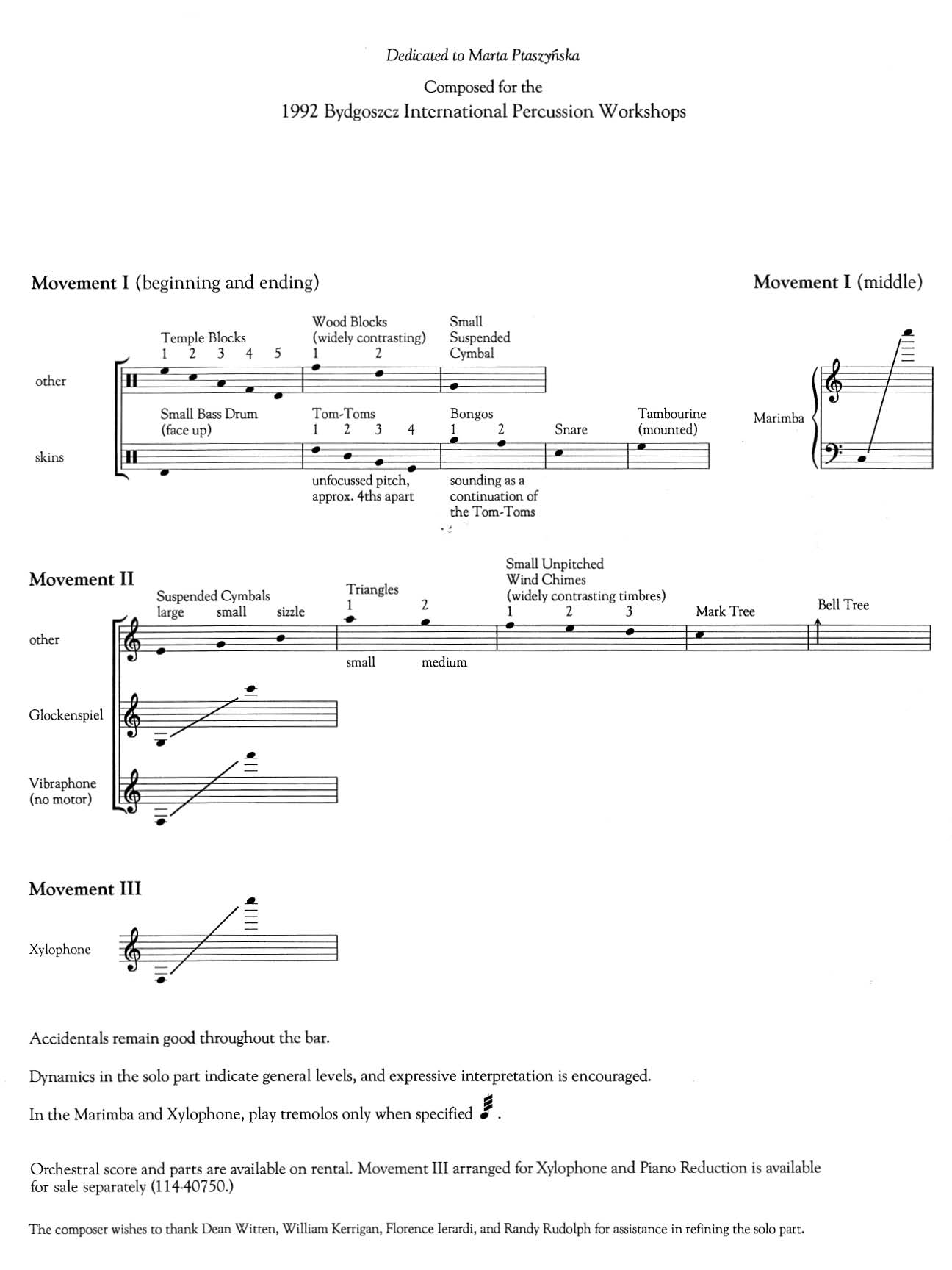
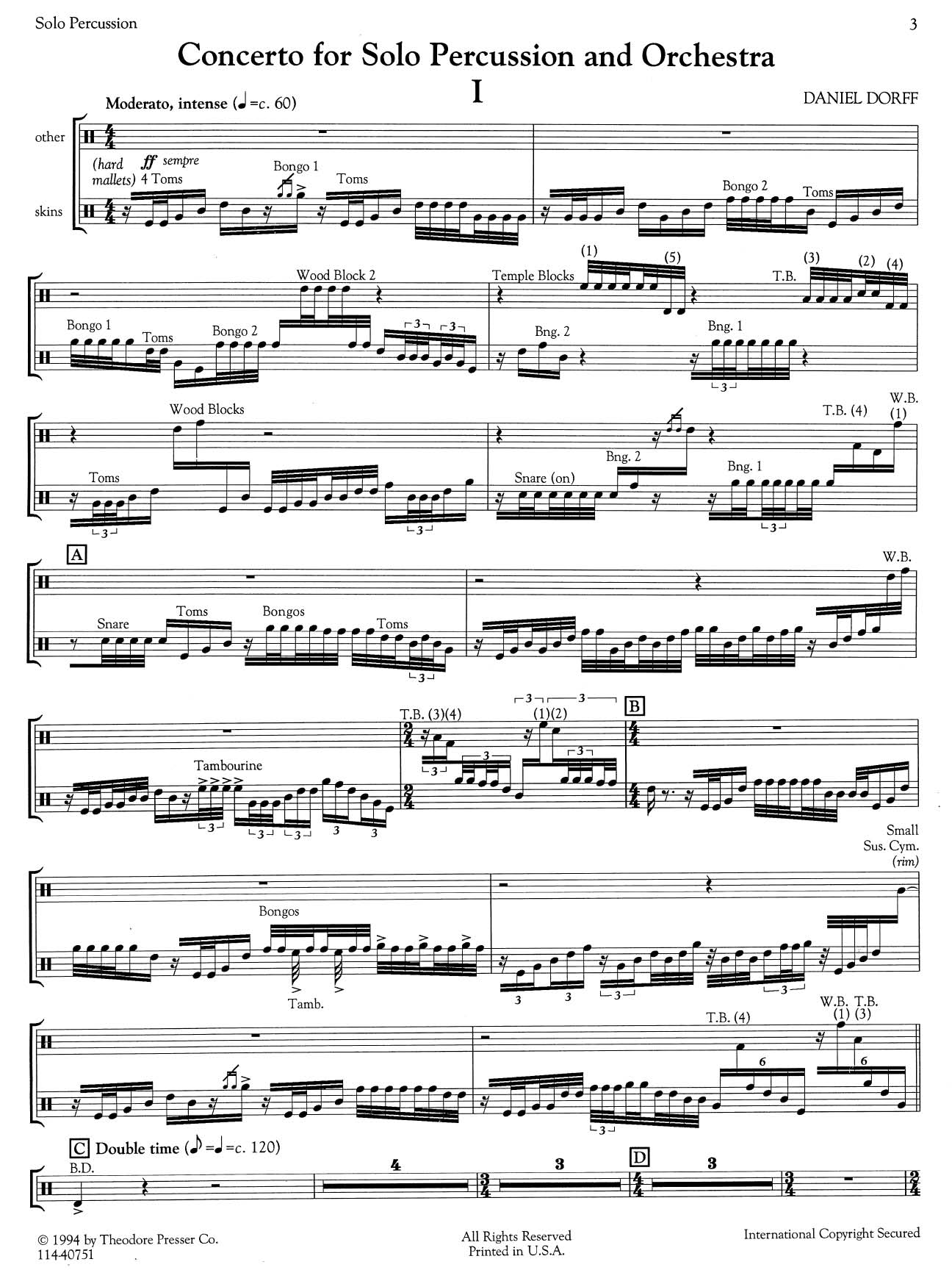
INSTRUMENTATION: 2(Picc)222-4331 Timp 3Perc Hp Strings DETAILS COMMISSIONED by the Polish Chapter of the Percussive Arts Society for the International Music Workshops in Bydgoszcz, Poland. PREMIERED March 18, 1995 by Haddonfield (NJ) Symphony, Dean Witten, solo percussion, Alan Gilbert, conductor. Movement III, Allegro Volante for Xylophone and Orchestra is also available separately. HEAR excerpts from Dean Witten's premiere with the Haddonfield Symphony, Alan Gilbert conducting: from Mvt. 1 from Mvt. 2 from Mvt. 3 BUY: Solo part from your favorite sheet music dealer, or direct from Presser. Piano reduction from your favorite sheet music dealer, or direct from Presser. Orchestra score from your favorite sheet music dealer, or direct from Presser. Orchestral score and parts are on rental from Presser. PROGRAM NOTES In March 1991 I heard Dean Witten perform Milhaud's Concerto for Percussion with the Haddonfield Symphony. I was fascinated with the idea of a concerto for mixed percussion and was sorry Milhaud's was so short, since it seemed such a ripe idea. Only two weeks later, the Percussive Arts Society's Polish Chapter commissioned me to compose a full-length percussion concerto for the 1992 International Percussion Workshops in Bydgoszcz, Poland. Since my music is primarily lyrical, and most percussion isn't, it was a fascinating challenge to create an idiomatic and gratifying concerto. It was also fun to exploit the many sounds available in a musically coherent way. In the 1st movement the soloist enhances the form by using a large set-up of unpitched percussion for the main theme section, with marimba for the middle contrasting section. The 2nd movement focuses on metal instruments, mixing pitched with unpitched. The 3rd movement is even more focused, using only xylophone. * * * In 1991, Poland was an inspiring model of people's solidarity working to overcome Soviet oppression, just as Poland has been known for its resilient spirit and Russia for its awesome regimes throughout history. I couldn't help but be aware of this in composing the concerto, as the conflict was at the forefront of world politics at the time, and my ancestry is from these two countries. While the concerto is built in the traditional three-movement concerto form, it also has a dramatic progression from awesome repression to triumph of the spirit. The motif A-G-F-high E recurs and transforms throughout the concerto as an indicator of this struggle. On August 18 (1991), I finished drafting the end of the first movement which is the concerto's darkest and most awesome depiction of Soviet control; ironically only two hours later, Gorbachev was deposed by the communist old-guard, leading to the collapse of the Soviet Union. The historic events which followed in Eastern Europe led to financial trouble for the Bydgoszcz percussion festival, and the premiere was cancelled. Continuing full circle, the concerto was premiered a few years later by Dean Witten as soloist with the Haddonfield Symphony, conducted by Alan Gilbert. The final movement, Allegro Volante, is also available for Xylophone with Band, and for Xylophone with Piano. REVIEWS "it is only a truly inventive and inspired composer like Mr. Dorff who is able to go one step further [than just using many percussion instruments] and create unusual sounds, textures, and combinations that work for the listener." – Maestro Alan Gilbert "impressive... highlighted the concert... It exploits the full range of sonorities and technical possibilities of a whole arsenal of percussion instruments... most arresting... a joyous finale... bold and extroverted but also filled with sensitive details." – Camden Courier-Post (Baxter), March 22, 1995. "An entertaining piece, exceptionally well received by the audience." – Penn Sounds (Sigal), Winter 1993. Complete review by John Beck in Percussive Notes |
 |
| |
 |