Music by DANIEL DORFF |
 |
| PROGRAM NOTES by the composer | |
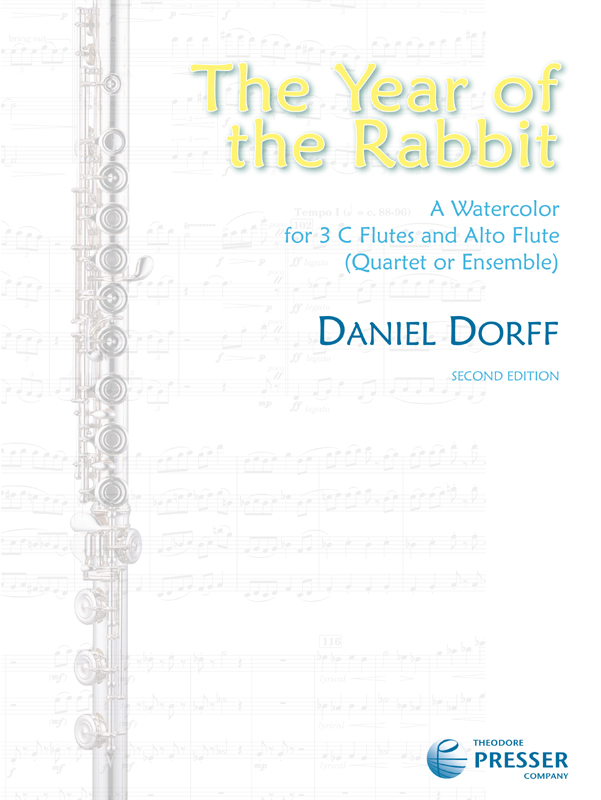
The Year of the Rabbit A Watercolor for 3 C Flutes and Alto Flute (quartet or ensemble) |
|
|
Seeing
those works displayed in June 1997, I was most taken by the many carvings
dedicated to the Asian Zodiac cycle. Many artists in various media and styles
have depicted the twelve-year animal cycle as a set of stylized carvings or
drawings, and I've been eager to create a musical parallel ever since this
visit.
In
late January 1999, flutist-composer Alexandra Molnar-Suhajda asked if I had any
new flute choir music that her ensemble could premiere at the Mid-Atlantic Flute
Fair in February. I didn't, but it struck me that a flute choir would be good
to portray the "year of the rabbit," which was coincidentally
beginning that weekend.Within a few days the piece was started and finished. The
music, in various ways, pays homage to the many "Rabbits" in my
immediate family, to rabbits in general, and to the Chinese astrological sayings
about people born in the year of the rabbit.
THE
YEAR OF THE RABBIT is dedicated to Alexandra Molnar-Suhajda, who (I later
discovered) was also born in the Year of the Rabbit.
ABOUT
THE SECOND EDITION (2014) The
original 1999 edition of THE YEAR OF THE RABBIT was engraved hastily out of
concert scheduling necessity; its lack of cues, visual clumsiness, and
insufficient cautionaries, has made the music much harder to play than it
actually is. This new edition is larger, better spaced, has ample cues and
cautionaries, and also has a handful of minor musical revisions to help smooth
performance. The composer thanks all the flutists who asked for better parts,
and in particular Cindy Anne Broz and Anne Levinson of Flûtes de Salon, and
Ellen Fisher Deerberg of the Volanti Flute Quartet, for specific suggestions
leading to improved articulations and other idiomatic details. PERFORMANCE
SUGGESTIONS Challenges
in tonguing, fast breaths, and dynamics have been improved in the second
edition, which is much better for performance. THE
YEAR OF THE RABBIT may be performed by a quartet or an ensemble. While a solo
quartet is the most light and supple, the use of multiple players allows for
solo/tutti contrasts and staggered breathing. ERRATA
IN THE SECOND EDITION Flute
2, m. 171: Please delete the stray grace note. |
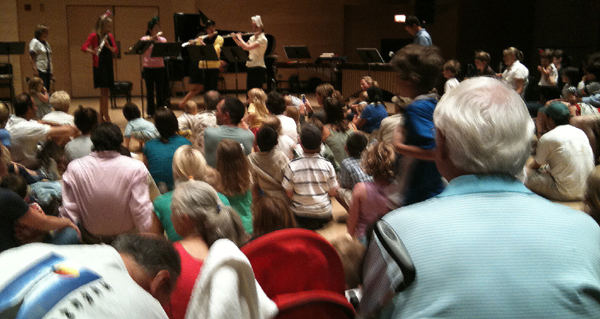 2010 performance at Aspen Music Festival all-Dorff children's concert |
last updated February 21, 2020 home |
|