Music by DANIEL DORFF |
 |
| PROGRAM NOTES by the composer | |
|
The Kiss (after the painting by Gustav Klimt) for Orchestra |
|
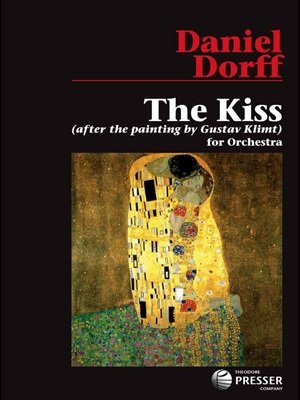
When the Philadelphia Museum of Art hosted a Brancusi show in 1996, the image of his sculpture The Kiss was frequently seen around the city. Brancusi's Kiss has powerful energy yet is a very static image, and this got me thinking about how Brancusi's Kiss would sound if it were music. >Its contrast to the active passion of Rodin's The Kiss made an interesting counterpoint, and I began imagining an orchestral suite with movements for Kiss sculptures by Brancusi and Rodin, and paintings by Munch and others. In February 1997, following a performance of my Summer Solstice, clarinetist John Bruce Yeh asked what I was writing next. When I mentioned this kiss-inspired suite, John reached for his wallet and pulled out a miniature of Gustav Klimt's The Kiss, and the painting became an immediate addition to my plans. In beginning to sketch the suite, I realized that movements which best portray each of these diverse painters and sculptors would not belong together in one piece, and my plans needed radical refining. In December 2000 Rossen Milanov invited me to write a piece for the Haddonfield Symphony - he specified music to open a concert, yet more substantial than an overture. Although I first proposed a tenor saxophone concerto, we agreed this work should be without a soloist. Over the next few weeks I explored ideas, and on a plane ride in early January 2001 I happened to look through SkyMall magazine and noticed an ad for art reproductions, with a large color picture of Klimt's The Kiss which I'd forgotten about. Looking at its mysterious sky and twinkling textures, the lovers lost to the world in their golden bubble, and the dazzling colors and patterns, musical ideas starting growing and it was clear that Klimt's Kiss would be the subject of my new work. When I announced this to Rossen, he was delighted and mentioned there's a framed reproduction of this painting hanging in his living room. He set the premiere for February 2002 on the Valentine's weekend subscription concert, paired with Prokofiev's Romeo and Juliet (meaning there would already be a tenor saxophonist hired for the concert). * * * My setting of The Kiss begins with a depiction of the painting's background, followed by music illustrating the lovers from bottom to top, starting from their tingling toes and progressing up their bodies, through their hearts, and up to their heads - where their minds are and where the actual kiss takes place. The first musical segment captures the general darkness of the sky and brilliant twinklings within it, as well as the happily mysterious mood of the young lovers in the midst of discovering each other. The gold bubble enveloping them represents their romantic cocoon, dazzling from the excitement of this new experience and isolating them from the outer world, the bubble depicted here by a gently whirring celesta which frames the musical trip through the lovers. Metallic stars in the painting inspired frequent use of glockenspiel and triangles in the music. The second section (starting at bar 77) is a light scherzo depicting the tingly feeling of joyous novelty and excitement. This giddy segment is full of innocent and charming duets, probably representing the feminine side of Klimt's embrace as well as the sheer happiness of new love. This scherzo is interrupted by a darker dance (bar 200) led by an intrusive tenor saxophone and trombone, sometimes sweet and sometimes aggressive, with a rough undercurrent of drums. This represents the uncertain (and perhaps threatening) influence of lust on the new young lovers, a heightening of the previous excitement level, or simply the masculine side of Klimt's embrace. It also reflects a more complicated relationship than the naive scherzo. Continuing forward, both through the painting and through the developing relationship between the couple, the following section (bar 321) is a series of climaxes representing their hearts and passions. Dazzling and dizzying, it's a brilliant scene within the lovers' imagined golden bubble, cloistered from the dark night. In Klimt's painting, the visual texture and impassioned embrace are intense, but the actual kiss is of secondary importance. Unlike much art on this topic, the kiss itself is not mutual; Klimt's young woman receives a kiss on the cheek. In a similar vein, my orchestral setting ends not with fireworks, but with a tender and gentle resolution of an intimate scene that has been glorified and exaggerated by peripheral excitement. Since the music is generally very rhythmic and structured as a dramatic progression toward the final kiss, it can also be perceived as a courtship over time which may be performed as a ballet leading to a final scene matching the painting. |
|
| last updated February 21, 2020 home |
|