Music by DANIEL DORFF |
 |
| PROGRAM NOTES by the composer | |
| Ave Maria for Voice and Piano (or 5 instruments) | |
|
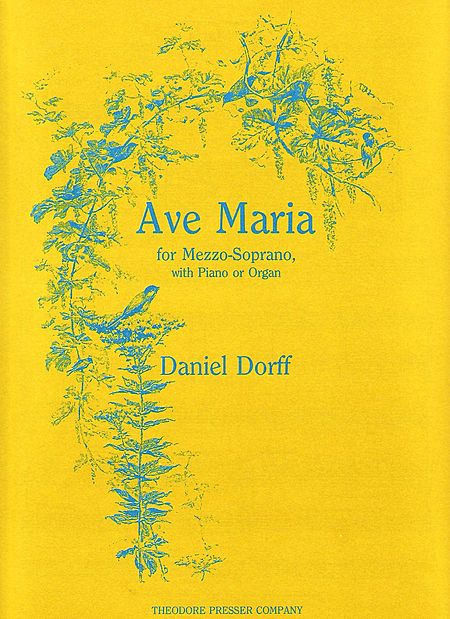
The first version of Ave Maria was composed in high school around 1973 for Diane Rama, a classmate who is now a successful soprano in Italy. My setting was naively overdramatic, and in 1980 I changed it considerably to become very pastoral and tender, using the same basic music. This new version was composed for Christina Lynn who premiered it in Philadelphia that summer, accompanied by Flute, Oboe, 2 Clarinets, and Glockenspiel. |
 |
| He Is Love for Voice (or 2-part chorus) and Piano (or brass quintet) | |
|
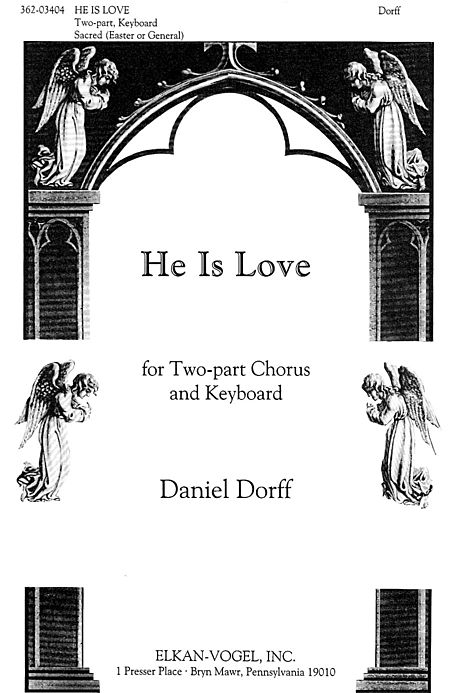
In late 1980 I received a Christmas card from Pat Silver, a graphic designer who had written a short poem and illustrated it for her annual Christmas card. I replied by setting Pat's poem to music, changing a few words to fit my idea of the song. I called the song Christmas and it was premiered with that title by Jody Applebaum in 1985, with Marc-André Hamelin at the piano. In 1999 I adapted it for 2-part treble chorus and also created a brass quintet accompaniment for soprano Yukiko Ishida's performances in Tokyo. Also in 1999, the 2-part choral version went into production at Elkan-Vogel; just before going to press under the title Christmas, my colleagues pointed out that despite the origin of the poem, it's not a nativity song though it could be used at Christmas season; more appropriate would be Easter or throughout the year. We retitled it from the line He Is Love to best express the meaning of the song. |
 |
| Kokoro o komete for Voice and Piano | |
|
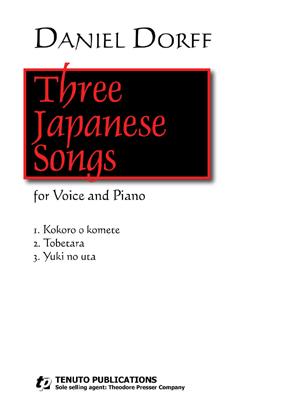
In July 1982, I was engaged to Japanese sculptor Eiko Fan Takahira, and her mother and sister came to the US to check me out. One morning, Eiko's sister, then 15 years old, didn't come downstairs for breakfast, and when she finally appeared she gave us a poem she'd spent the morning writing, called Kokoro o Komete. It expressed how she felt losing her sister to marriage in a distant country. When they all left the house that afternoon for yard sales, I wrote this song on her poem. It was premiered a few months later at our wedding. I made a point of using a musical style balancing Western harmony with the pentatonic and Phrygian flavor found in much Japanese folk music. |
 |
| Yuki no uta for Voice and Piano | |
|
I
composed a Snowy Evening in 1973, when I was in high school. To me, snow is very special and magical. The world seems changed when covered by a blanket of snow. When Yukiko Ishida asked me to write a new song to premiere at Suntory
Hall, I remembered how beautifully she sings Snowy Evening, so I wanted to write
a new song about snow, which is also the meaning of the name Yuki. |
|
last updated February 21, 2020 home |
|